
Money Matters - Simplified
Scientists Discover Monster Sea Scorpion Fossil
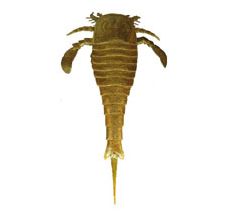
Scientists in Germany have come across a fossil they say is a body part of possibly the biggest sea scorpion ever. Making the announcement on Tuesday, scientists said they had discovered the fossilized claw of a 390-million year old sea scorpion species going by the scientific name Jaekelopterus rhenaniae.
 Get original file (4KB)
Scientists said this sea scorpion was the size of a big crocodile and was one of the most ferocious predators of its time. Its diet included fish and even other scorpions that it found in the swamp waters in coastal regions.
The scientists who made the discovery based their estimated measurements of the size of the sea scorpion on the basis of the size of the claw they found. The fossilized claw they discovered is spiked and 18 inches (46 centimeters) long, from which the scientists calculated the length of a full-grown scorpion of this species to be 8.2 feet (2.5 meters).
Besides the excitement that the discovery of a monster bug generates, the discovery has a lot of scientific significance as well. It proves that arthropods, i.e. animals with exoskeletons, segmented bodies, and joint limbs were not always the small size they are today.
As Simon Braddy, a paleobiologist at the University of Bristol in the U.K. said, the discovery of the fossilized claw proves that there once lived arthropods that were many times larger than the kind we find today. Calling the discovery ‘amazing’, Braddy said while there was evidence of super-sized bugs from the early periods; no one had an exact notion of just how big they could have been, until now.
Braddy said the scorpion could not have been a land-based animal, as its legs were not strong enough to support the rest of the body. He said water must have been an essential factor for its survival, as it would have helped make it buoyant.
University of Kansas paleontologist Paul Selden said that scientists already knew about the existence of J.rhenaniae. While people knew about the existence of the species, no one knew anything about the fact that it could grow so big, Selden said.
Owing to its huge size, Selden said its diet would consist of any animal smaller than itself, including other scorpions. He said the claws of the scorpion had long and sharp teeth that it used to effectively grasp its prey.
Berlin Museum’s curator of arthropod exhibits, Jason Dunlop, said the new fossil made J.rhenaniae the biggest arthropod species to be discovered ever. Its closest competition so far is a species of gigantic millipedes measuring at least 2 meters or 6.5 feet in length. Other such arthropods discovered include giant dragonflies with wings as wide as those of sea gulls.
Belonging to the group Eurypterids, the newly discovered fossil indicates that the sea scorpion could probably have been at least 18 inches larger than any other prehistoric sea scorpions scientists had records of.
Markus Poschmann of the Mainz Museum in Germany found the fossil in a quarry near Prum. When the fossil was discovered, it was found trapped inside rock layers. The layers of rock covering the fossil indicate it possibly lived in a coastal swamp, or probably a river delta.
Poschmann and Braddy co-authored the report of the discovery. They have published their findings in the latest issue of Biology Letters, a biological journal.