

Thursday
Jun 12
|
|
||||
|
Thursday Jun 12
|
|||
| |
||||
Skip 'Kiss of Life' in cardiac arrest - Studyby Shubha Krishnappa - March 16, 2007 - 0 comments
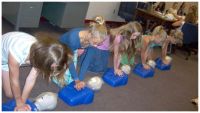 Skipping the mouth-to-mouth portion of cardiopulmonary resuscitation (CPR) can significantly increase the chances of surviving a cardiac arrest without brain damage, according to a large new study published on March 17, 2007 issue of The Lancet, one of the world’s foremost medical journals, bringing down a century of conventional medical wisdom. Instead of traditional CPR with mouth-to-mouth breathing, the chances of surviving a cardiac arrest outside a hospital setting are twice as high if bystanders perform chest-compression-only resuscitation, according to the study that could lead to an amendment in resuscitation guidelines for a "witnessed sudden collapse." For the last 40 years, CPR instructors were instructing people to give 15 chest compressions followed by two mouth-to-mouth ventilations. In 2005, the new guidelines raised the compressions figure to 30 for every two breaths. But Dr. Ken Nagao of the Surugadai Nihon University Hospital in Tokyo and his colleagues in their new study, which analyzed the outcomes of 4,068 cases of witnessed collapse of adults in the Kanto area in Japan, say chest compressions without mouth-to-mouth ventilation saves twice as many heart attack victims as traditional CPR. Of the overall victims, 72% received no resuscitation at all from bystanders, 18% received conventional CPR and 11% received only cardiac compression. “The report confirms that what we have learned in animal experiments applies to humans as well,” says Gordon A. Ewy, MD, director of the Sarver Heart Center at The University of Arizona in Tucson where chest-compression-only resuscitation was developed. “Bystander-initiated continuous chest compressions without mouth-to-mouth breathing are the preferable approach for witnessed unexpected collapse, which is usually due to cardiac arrest,” said Ewy, dubbed the "CPR giant" by the American Heart Association. However, the experts cautioned that the new findings apply only to people who collapse suddenly from a heart attack. Those suffering from respiratory arrest, such as near-drowning, drug overdose or choking, still require conventional cardiopulmonary resuscitation, i.e. 2 breaths after every 30 chest compressions. "If you pull somebody out of a swimming pool who's not breathing, that's a respiratory arrest. Or if somebody has a drug overdose and just stops breathing, that's a respiratory arrest," Dr. Ewy said. In their study, the researchers found that benefit of compression-only resuscitation was even greater in patients with the best chance of surviving, meaning those patients whose hearts are in a "shockable" rhythm when the paramedics arrive. In that group, the experts noticed the proportion of people who had better outcomes was 11.2% in those who received conventional 2 mouth-to-mouth breaths after every 30 chest compressions, while it was 19.4% in the chest-compression-only group. People who had resuscitation started within four minutes of their cardiac arrest also showed better results, with ratio of 10.1% compared to 5.1% of the CPR group. During a cardiac arrest that mostly cause by an electrical disturbance called ventricular fibrillation the heart stops beating. |
|
||||||
Disclaimer: The views and investment tips expressed by investment experts on themoneytimes.com are their own, and not that of the website or its management. TheMoneyTimes advises users to check with certified experts before taking any investment decision. ©2004-2008 All Rights Reserved unless mentioned otherwise. [Submit News/Press Release][Terms of Service] [Privacy Policy] [About us] [Contact us] |


