

MARSIS scans vast ice deposits on Mar's south pole
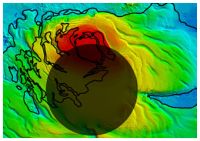
A spacecraft orbiting Mars has shown some astonishing data related to South Polar Region of Mars, indicating extensive frozen water that according to NASA can cover the entire surface of the planet in 36 feet (11 meters) of water if it were melted.
To reach the conclusion scientists used a joint NASA-Italian Space Agency radar instrument on the European Space Agency's Mars Express that scanned the thickness and volume of ice deposits at the Martian South Pole covering an area larger than Texas.
Scientists who reported their findings in the March 15 online edition of the journal Science said Mars Express orbiter's radar instrument that sees through icy layers to the lower boundary, which is as deep as 3.7 kilometers (2.3 miles) below the surface, has made more than 300 virtual slices through layered deposits covering the pole to gauge the ice.
"The south polar layered deposits of Mars cover an area bigger than Texas. The amount of water they contain has been estimated before, but never with the level of confidence this radar makes possible," said Jeffrey Plaut of NASA's Jet Propulsion Laboratory (JPL), Pasadena Calif, who is co-principal investigator for the radar and lead author of the study, which was jointly funded by the ESA and the U.S. National Aeronautics and Space Administration (NASA).
The deposits, which according to the scientist are Mars's largest known deposit of water ice mapped by the radar instrument, named the Mars Advanced Radar for Subsurface and Ionospheric Sounding (MARSIS), are under a polar cap of white frozen carbon dioxide and water, and appear to be composed of at least 90 percent frozen water, with dust mixed in, the study said.
"Our radar is doing its job extremely well," said Giovanni Picardi, a professor at the University of Rome "La Sapienza," and principal investigator for the instrument. "MARSIS is showing itself to be a very powerful tool to probe underneath the Martian surface, and it's showing how our team's goals,such as probing the polar layered deposits, are being successfully achieved," Picardi said.
MARSIS is also mapping the thickness of similar layered deposits at the north pole of Mars. Scientists have long known that Mars’ north polar cap is an abundant source of water ice, and the current research team says they will use their radar technique to refine past estimates of its thickness and make-up.
Plaut said the South Pole served as a “cold trap” for water that once flowed freely over the Martian surface. He said that studying this area could help researchers determine whether Mars has ever supported life.
The new study even indicates the possible existence of a thin layer of liquid water at the base of the deposits.

 delicious
 digg
digg




