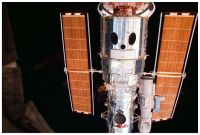
The most significant scientific instrument of Hubble Space Telescope (HST) has stopped working due to an electrical short circuit, US space agency National Aeronautics and Space Administration (NASA) announced Monday.
The Advanced Camera for Surveys (ACS), the most high-tech camera on the telescope responsible for capturing some of the most detailed and remarkable images of the universe, has broken down last weekend after a fuse failed as a result of a short circuit.
According to NASA officials, two of ACS’s main capabilities, gaining ultra deep views of the universe and thorough data on individual stars, are improbable to get back in normal condition.
Installed on the Hubble in 2002, the ACS, which photographs huge expanses of sky, consists of three electronic cameras, and detects and filters light, from the ultra-violet to the near infra-red.
The US space agency, which described the failure as a "great loss", said Hubble’s Solar Blind Channel will still be usable, while the ACS will never be fully operational again.
"Science will continue, but it's a great loss, no doubt," Mario Livio of the Space Telescope Science Institute which manages Hubble, said. "This was a fantastic camera that just produced incredible science."
The telescope moved into "safe mode" on Saturday (Jan 27) after a short circuit in the ACS, as per told by the Hubble programme manager, Preston Burch.
The camera, which has been taking pictures of faraway galaxies since 2002, had struck by a series of electrical problems since last summer, and had already been running on its back-up electronics because of a breakdown last June.
US space agency engineers are still ambiguous whether the state-of-the-art camera will ever work again.
Two of the instrument's three channels, Wide Field Channel and High Resolution Channel, were unlikely to be restored, NASA engineers said. Hubble's other instruments, which include the Field Planetary Camera-2 and the Near Infrared Camera Multi-Object Spectrograph are working properly.
Hubble is due to receive a new camera system, the Wide Field Camera 3 (WFC3), during a planned servicing mission by space shuttle in 2008. Once the WFC3 installs on Hubble, the ACS, which has taken the clearest pictures ever seen of the cosmos, will recover all of the capability lost in the latest failure and will become fully functioning.
"The successful completion of [the shuttle mission] and insertion of Wide Field Camera-3 (WFC3) will take us fully back to not only where we are now, but where we want [the telescope] to be in the future," said David Leckrone, Nasa's senior project scientist on Hubble.




Recent comments
11 hours 33 min ago
22 hours 12 min ago
1 day 1 hour ago
1 day 1 hour ago
1 day 6 hours ago
1 day 6 hours ago
1 day 7 hours ago
1 day 7 hours ago
1 day 13 hours ago
2 days 5 hours ago