Sunday
Oct 21
|
|
||||
|
Sunday Oct 21
|
|||
| |
||||
COROT to Probe Inside Mystries of Starsby Shubha Krishnappa - December 28, 2006 - 0 comments
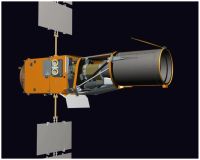 COROT, a space mission approved and led by the French Space Agency (CNES), has successfully started its journey Wednesday to probe the space, in order to accomplish its twin scientific goals, one to detect extra solar planets orbiting around other stars and the other to probe the mysteries of stellar interiors. A modernized Soyuz 2-1b launcher, carrying COROT satellite, took off from launch pad #6 of the Baikonour cosmodrome in Kazakhstan at 2.23pm UK time on Wednesday and successfully placed the satellite in orbit to seek out Earth-like planets beyond the solar system and to explore the interior of stars, the French space agency CNES said. Soon after the launch, CNES president Yannick d'Escatha announced, "Our COROT satellite has been put into orbit today perfectly by a Soyuz rocket." COROT, which stands for 'Convection Rotation and planetary Transits' is the unique astronomy mission and is equipped with a 27-cm diameter afocal telescope that is capable of detecting planets smaller than those currently known and a 4-CCD camera sensitive to tiny variations of the light intensity from stars. The telescope is even capable of detecting those planets which are just a few times the size of Earth and rocky rather than gaseous. It will monitor some 120 000 stars from an orbit more than 500 miles above Earth with its telescope. To explore the inner structure of the stars and to detect many exoplanets, the COROT will use an unusual method, called stellar seismology, and its instrument will make the probe possible by observing the periodic micro-eclipses occurring when these bodies transit in front of their parent star. During its two-and-a-half-year mission, COROT pledges a bold new search for planets around other stars, providing knowledge about the smaller, rocky planets to the scientists by using the state-of-the-art technology. The satellite will also be able to detect 'starquakes', acoustic waves generated deep inside a star that send ripples across its surface, altering its brightness. More than 200 planets have been discovered around stars beyond the solar system using ground-based observatories but they have never been seen. The technique was not so advanced and only worked well for huge planets, that’s why nearly all, found so far, are gas giants, planets at least as big as Jupiter. COROT is a French national space agency (CNES)-led mission, and besides the European Space Agency (ESA), which will measure the light emitted by a star and detect the drop in brightness caused when a planet passes in front of it, the other European partners including Germany, Spain, Belgium, Austria and Brazil are also associated with the project. The US space agency NASA is due to launch Terrestrial Planet Finder, another space telescope capable of detecting Earth-sized planets, in 2008. Scientists and astronomers are eagerly waiting for the first measurement from COROT, and hoping to obtain an advanced vision of planet systems beyond the solar system from the probe. |
|
||||||
Disclaimer: The views and investment tips expressed by investment experts on themoneytimes.com are their own, and not that of the website or its management. TheMoneyTimes advises users to check with certified experts before taking any investment decision. ©2004-2007 All Rights Reserved unless mentioned otherwise. [Submit News/Press Release][Terms of Service] [Privacy Policy] [About us] [Contact us] |