Professor Jan Bjordal of Bergen University College in Norway, working with a team of Brazilian researchers, studied the pain relieving, anti-inflammatory 'cold laser,' finding it caused increased tumor growth in a mouse model of skin cancer.
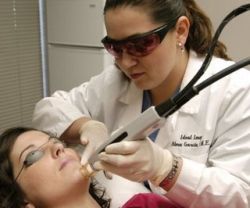
The scientists said laser therapy was developed in the 1970s, and has been marketed as a treatment for hair-loss, pain management, sports medicine and skin care. They noted home-treatment sets can be purchased online for unsupervised use.
Bjordal said low-level laser therapy has gained popularity as a treatment for soft tissue injuries and joint conditions.
"However, there is a shortage of evidence, especially in vivo evidence, about the effects of (such laser therapy) in malignant conditions such as melanoma," he said.
Bjordal said he and his colleagues applied the low-level laser therapy to cancer cultures and to mice injected with melanoma cells. Although the treatment didn't cause any significant changes in the cell cultures, direct irradiation of the tumor with high-dose low-level laser therapy caused a significant increase in tumor mass volume and considerable cellular alterations, indicating a worsening of the cancer in the mice.
The findings of the study are to appear in the journal BMC Cancer.
Copyright 2009 by United Press International.



Post new comment